Security Operations Tools 2026
Security Operations covers the people, tooling, and workflows that detect attacks, investigate them, and contain them before they become breaches. It is where the SOC actually runs: log collection and SIEM, the detection engineering that turns telemetry into alerts, the triage and incident response that follows, and the offensive testing that pressure-tests all of it. The space spans buy-versus-build decisions, from fully managed detection and response to in-house threat hunting, plus the forensics, malware analysis, and SOAR automation that hold an operation together. If your job is cutting dwell time and mean time to respond, this is the machinery you do it with.
We cover 2105 Security Operations tools, 1376 free and 729 commercial.
Accuracy and depth improve over time. Last reviewed Aug 2026. Is something off? Reach out.
FEATURED

Top Security Operations Tools

Managed Agentic Threat Hunting Service (IOC sweeps and hypothesis based hunting)
USE CASES

SOARCA is an open-source SOAR platform that automates security incident response workflows using standardized CACAOv2 playbooks and multiple integration interfaces.

A free, open-source file data recovery software that can recover lost files from hard disks, CD-ROMs, and digital camera memory.
A tool collection for filtering and visualizing logon events, designed for experienced DFIR specialists in threat hunting and incident response.
A Bluetooth 5 and 4.x sniffer using TI CC1352/CC26x2 hardware with advanced features and Python-based host-side software.
A software that collects forensic artifacts on systems for forensic investigations.
A command that builds and executes command lines from standard input, allowing for the execution of commands with multiple arguments.

Autopsy is a GUI-based digital forensics platform for analyzing hard drives and smart phones, with a plug-in architecture for custom modules.
A library for working with Windows NT data types, providing access and manipulation functions.

Request Tracker for Incident Response (RTIR) is a tool for incident response teams to manage incident reports, correlate data, and facilitate communication.
A static analysis tool for PE files that identifies potential malicious indicators through compiler detection, packing analysis, signature matching, and suspicious string identification.

A tool that collects and displays user activity and system events on a Windows system.

A dynamic GUI for advanced log analysis, allowing users to execute SQL queries on structured log data.
A library for accessing and parsing OLE 2 Compound File (OLECF) format files, including Microsoft Office documents and thumbs.db files.

Search engine for Windows executable files and hashes, providing insights into file prevalence, behavior, and security information.
A collection of Python scripts for password spraying attacks against Lync/S4B & OWA, featuring Atomizer, Vaporizer, Aerosol, and Spindrift tools.
An open source format for storing digital evidence and data, with a C/C++ library for creating, reading, and manipulating AFF4 images.
A library to access FileVault Drive Encryption (FVDE) encrypted volumes on Mac OS X systems.

TestDisk is a free data recovery software that can recover lost partitions and undelete files from various file systems.

A digital archive of the internet, allowing users to capture and browse archived web pages.
A tool that extracts and deobfuscates strings from malware binaries using advanced static analysis techniques.
JIMI is a flow-based orchestration automation platform that combines low-code and no-code capabilities for multi-team collaboration across IT, security, and development operations.

Catalyst is a SOAR system that automates alert handling and incident response processes, adapting to your workflows and being open source.

Search engine for open-source Git repositories with advanced features like case sensitivity and regular expressions.
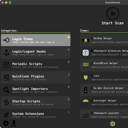
A free, open-source tool that uncovers persistently installed software on macOS, helping to generically reveal malware.
Security Operations Specializations
2105 tools across 15 specializations · 1376 free, 729 commercial
Digital Forensics
Digital forensics tools whose primary job is to collect, preserve, and analyze evidence after the fact.
Incident Response
Incident response tools and retainers whose primary job is to orchestrate live response to an active security incident.
Malware Analysis
Malware analysis tools whose primary job is to reverse-engineer, detonate, and classify malware samples.
How to choose Security Operations tools
- Map tools to your detect, investigate, respond gaps before shopping. A team drowning in alerts needs detection engineering and SOAR, not another data source feeding the SIEM.
- Check what telemetry a platform actually ingests and how it prices that volume. SIEM and XDR economics live or die on ingestion costs, and surprise log charges sink budgets fast.
- Decide build-versus-buy per layer, not all at once. You might run MDR for monitoring while keeping forensics and threat hunting in-house.
- Look at integration depth with the rest of your stack: EDR, identity, cloud, and ticketing. A SOAR or XDR tool is only as useful as the systems it can read from and act on.
- Weigh signal quality over feature count. A handful of high-fidelity alerts from deception and well-tuned detections beats a platform that floods analysts with noise.
- Account for the headcount each tool demands. Detection engineering, threat hunting, and self-run SIEM all assume skilled staff you can hire and keep.
Security Operations Tools FAQ
Common questions about Security Operations tools, selection guides, pricing, and comparisons.
It spans the full detect, investigate, respond cycle of a SOC. On the analytics side that means SIEM and log analytics, detection engineering, extended detection and response (XDR), threat hunting, and AI threat detection. For confirmed events it covers incident response, digital forensics, and malware analysis. Rounding it out are SOAR for automation, MDR for outsourced operations, and offensive disciplines: penetration testing, red-team and adversary emulation, bug bounty, honeypots and deception, and cyber range training.
SIEM aggregates and correlates logs from across your environment and is the traditional detection backbone. XDR narrows scope to vendor-integrated telemetry across endpoint, identity, email, and cloud with detections built in, trading breadth for tuned signal. MDR is the service layer: a provider operates detection and response for you, often on top of one of those platforms. SOAR sits across all of them, automating the repetitive triage and response steps analysts would otherwise do by hand.
It comes down to whether you can staff and retain around-the-clock detection talent, and whether your environment is unusual enough that generic detections miss your real risks. MDR gets you coverage fast without hiring, but you inherit the provider's detection logic and response speed. Building in-house gives you control over detection engineering and hunting tuned to your stack, at the cost of headcount, tooling spend, and the burden of 24/7 coverage. Many teams split the difference: MDR for after-hours, in-house for daytime depth.
They validate that detection and response actually work. Penetration testing finds exploitable gaps, red-team and adversary emulation test whether your SOC notices and reacts to realistic attack chains, and bug bounty crowdsources external discovery. Cyber range training keeps analysts sharp against live scenarios, and honeypots and deception generate high-fidelity alerts by catching attackers who touch fake assets. Together they answer the question dashboards cannot: would we have caught a real adversary?
For parts of the stack, yes. Strong open-source options exist for SIEM, malware analysis sandboxes, honeypots, and detection rule frameworks, and plenty of capable teams run them in production. The tradeoff is operational: you own tuning, scaling, content updates, and integration work that commercial platforms package up. Open source wins where you have engineering depth and want control. Commercial and managed offerings win where you need coverage, support, and speed without the staffing to maintain it yourself.