Threat Hunting Tools 2026
Threat hunting tools go looking for attackers who slipped past automated detection, instead of waiting for an alert to fire. Sitting inside Security Operations, this category covers the platforms, analytics engines, and frameworks that let hunters form a hypothesis about adversary behavior, then query telemetry across endpoints, network traffic, identity, and cloud to prove or disprove it. The work targets the quiet stuff: living-off-the-land techniques, slow lateral movement, and persistent intruders that signature-based detection routinely misses. For a CISO, this is where you find out whether your SOC is genuinely proactive or just reacting to whatever the SIEM happens to flag.
We cover 94 Threat Hunting tools, 60 free and 34 commercial.
Accuracy and depth improve over time. Last reviewed Oct 2026. Is something off? Reach out.
FEATURED

USE CASES
New to this category? What is Threat Hunting?

PCAPdroid is a privacy-friendly app for tracking, analyzing, and blocking network connections on your device.
A PowerShell obfuscation detection framework designed to highlight the limitations of signature-based detection and provide a scalable means of detecting known and unknown obfuscation techniques.
A repository to aid Windows threat hunters in looking for common artifacts.
A threat hunting tool for Windows event logs to detect APT movements and decrease the time to uncover suspicious activity.
Windows event log fast forensics timeline generator and threat hunting tool.
A community-driven informational repository providing resources and guidance for hunting adversaries in IT environments.
Sysmon for Linux is a tool that monitors and logs system activity with advanced filtering to identify malicious activity.
ZAT is a Python package that processes and analyzes Zeek network security data using machine learning libraries like Pandas, scikit-learn, Kafka, and Spark.
CimSweep is a suite of CIM/WMI-based tools for incident response and hunting operations on Windows systems without the need to deploy an agent.
Scumblr is a web-based security automation platform that performs periodic data source synchronization and security analysis to help organizations proactively identify and track security issues.
A lightweight bash script IOC scanner for Linux/Unix/macOS systems that detects malicious indicators through hash matching, filename analysis, string searches, and C2 server identification without requiring installation.
Lists of sources and utilities to hunt, detect, and prevent evildoers.
Powershell Threat Hunting Module for scanning remote endpoints and collecting comprehensive information.
An interactive command line application for Open Source Intelligence collection and artifact management that enables investigation of IP addresses, domains, email addresses, file hashes, and other digital artifacts.
A community-driven repository of pre-built security analytics queries and rules for monitoring and detecting threats in Google Cloud environments across various log sources and activity types.
A threat hunting capability that leverages Sysmon and MITRE ATT&CK on Azure Sentinel
A tool collection for filtering and visualizing logon events, designed for experienced DFIR specialists in threat hunting and incident response.

Search engine for Windows executable files and hashes, providing insights into file prevalence, behavior, and security information.

Search engine for open-source Git repositories with advanced features like case sensitivity and regular expressions.
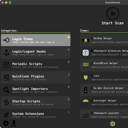
A free, open-source tool that uncovers persistently installed software on macOS, helping to generically reveal malware.
How to choose Threat Hunting tools
- Check what telemetry it can actually query. A hunt is only as good as the data behind it, so confirm coverage across endpoint, network (packet and flow), identity, and cloud logs, and whether it normalizes them into one searchable surface or makes you pivot between consoles.
- Look at retention and query speed over long time windows. Real intrusions span months, so the tool needs to search far back without choking, and the cost of keeping that data hot should be predictable.
- Assess how it encodes adversary knowledge. Strong tools map to a framework like MITRE ATT&CK and let you build, save, and rerun hypotheses, rather than starting every hunt from a blank query box.
- Separate genuine hunting from rebadged alerting. Some products labeled threat hunting are detection rule engines in disguise. The real test is whether an analyst can freely explore raw data, not just tune predefined alerts.
- Weigh build versus buy against your team's skill. Open analytics frameworks and query libraries reward strong analysts and data engineering; managed and agentic offerings suit teams that lack the headcount to hunt continuously.
- Confirm the path from finding to response. A hunt that surfaces an intruder is worthless if the result cannot feed your EDR, SIEM, or case management, so check integrations and whether confirmed findings can become durable detections.
Threat Hunting Tools FAQ
Common questions about Threat Hunting tools, selection guides, pricing, and comparisons.
Threat hunting is the proactive practice of searching an environment for attackers who evaded automated detection. Instead of waiting for an alert, a hunter forms a hypothesis about likely adversary behavior, then queries endpoint, network, identity, and cloud telemetry to confirm or rule it out. The goal is finding stealthy intrusions, like living-off-the-land activity or dormant persistence, that signature-based tools miss.
Detection and EDR tools fire alerts based on known indicators and rules, so they answer questions you already thought to ask. Threat hunting is human-led exploration of raw data to find what the rules do not catch. In practice hunting depends on EDR and SIEM telemetry as its data source, and a good hunt often ends by turning a discovery into a new automated detection.
Start with data access: confirm it can query endpoint, network, identity, and cloud telemetry over long retention windows at reasonable speed. Then check whether it maps to a framework like MITRE ATT&CK and lets analysts explore freely rather than just tune alerts. Finally, match the tool to your team. Open frameworks reward strong in-house analysts, while managed or agentic options fit lean teams.
Open-source analytics, query libraries, and frameworks are powerful and widely used by mature SOCs, but they expect you to supply the data pipeline, storage, and skilled analysts. Commercial platforms bundle data normalization, long-term retention, and guided workflows, and managed services add the hunters themselves. The right choice depends on whether your constraint is budget, engineering capacity, or analyst headcount.
Most small teams cannot staff continuous hunting, so a standalone platform may sit idle. They often get more value from the hunting features built into their existing EDR or SIEM, or from a managed or agentic hunting service that supplies the expertise. As the team grows and telemetry volume increases, a dedicated tool that lets analysts explore data directly becomes worth the investment.











